This glossary explains biological, botanical, zoological and mycological terms, as well as terms used in cecidology. It is intended to make the numerous technical terms used in the photo gallery and on the information pages of this website easier to understand.
All | A | B | C | D | E | F | G | H | I | J | K | L | M | N | O | P | Q | R | S | T | U | V | W | X | Y | Z |
Abundance
The frequency or number of organisms, or in fungi also the number of fruiting bodies, in relation to a unit area or a vegetation type. Abundance is recorded in mycological ecological studies using various methods, for example by counting or weighing the fruiting bodies.
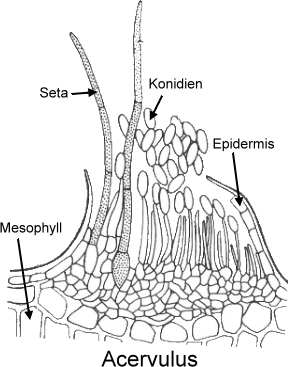
Acervulus
An acervulus is a conidioma of imperfect fungi, particularly of phytoparasites. It consists of a compact, sharply delimited, saucer-shaped mycelial cushion embedded in host tissue, on which the conidiophores are arranged in a palisade. The structure is initially covered by the host epidermis, which later ruptures when the conidia mature. Fungi forming acervuli are traditionally grouped in the form-order Melanconiales. Aleuriospores, blastospores or phialospores are formed in acervuli. Occasionally, the uredia and telia of Uredinales, and more rarely the sori of Ustilaginales, are also called acervuli.
Acidophilous
An ecological term for acid-loving species. Acidophilous fungi occur exclusively or preferentially on substrates with a pH below 6.5. See also basiphilous.
Adult
Adult is a synonym for mature and refers particularly to the life stage of an organism after reaching sexual maturity.
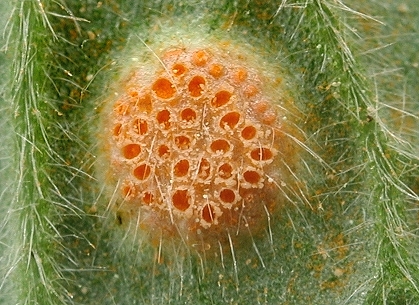
Aecidium
An aecidium is a cup-shaped spore-bearing structure in which the aecidiospores of rust fungi (Uredinales) are produced. Aecidia occur on the underside of the leaves of the host plant. The image shows a detail of Aecidium ranunculis-acris.
Aecium / Aecia
An aecium or aecia is a type of spore-bearing structure occurring in the secondary fruiting stage of rust fungi (Pucciniales), which grow as endoparasites of vascular plants. It consists of a mycelium with dikaryotic cells that produces aeciospores by budding. Depending on the form of their aecia, rust fungi whose main fruiting stage is unknown are traditionally divided into form genera: Caeoma for simple aecia without peridia, Aecidium for cup-shaped spore-bearing structures with peridia open at the top, Peridermium for aecia with walls initially closed like a dome, and Roestelia for species producing lattice-like peridia.
Agamous
Reproducing without fertilisation; also called asexual parthenogenesis.
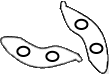
Allantoid
Cylindrically curved and single-celled, describing a spore shape that is bean- or sausage-like, especially in conidia and ascospores.
Amyloid
A violet or black coloration of cell walls, including spore ornamentation or spore deposits, in Melzer’s reagent. It is an important diagnostic feature, especially in white-spored fungal groups.
Anamorph
A developmental stage of pleomorphic fungi in which no meiospores are produced (the imperfect or secondary fruiting stage). Reproduction generally occurs through conidia. The opposite is a teleomorph, the main fruiting stage in which reproductive stages resulting from a sexual process produce meiospores.
Anastomoses
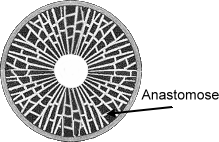
In botany, a variably used term for partial contact and fusion of xylem strands or leaf veins, or for the connection of two stronger leaf veins by two thinner ones. In mycology, it refers either to the connection of two hyphae of the same fungal species, by direct fusion or by lateral outgrowths, allowing the protoplasts to unite and nuclei to pass between cells, or to connections between the radially arranged gills on the underside of agarics.
Angiocarpous
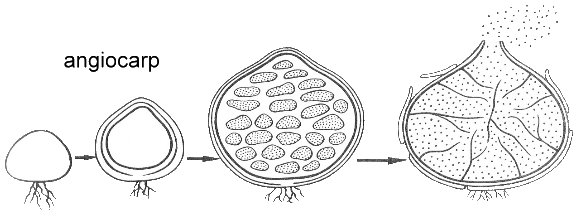
A term for fungal fruiting bodies with a preformed opening for spore dispersal that remains closed at least until the spores are mature, for example in gasteroid fungi, where the peridium often ruptures in a characteristic way, and in many ascomycetes.
Apical apparatus
The opening mechanism at the apex of the asci of ascomycetes through which ascospores are released; also called the ascus pore or apical opening.
Apophysis
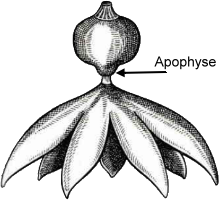
A swelling of a stalk at the base of a sporangium or spore, for example at the base of the endoperidium of some earthstars (Geastrales), or a ring-shaped swelling at the base of the capsule in some mosses.
Apothecium
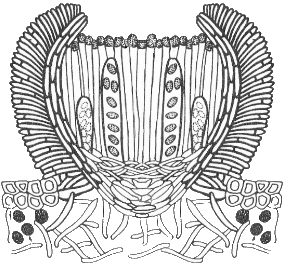
Apothecia are open, saucer-, disc- or cup-shaped fruiting bodies of ascomycetes or lichens. In contrast to the enclosed perithecium, the fertile spore-bearing surface is exposed.
Apterous
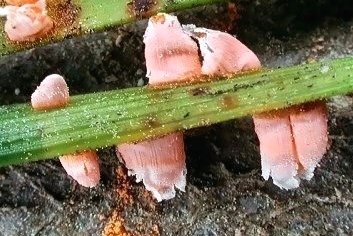
Completely wingless and incapable of flight; used particularly for insects.
Arboricolous
The way of life of animals that live mainly in tree crowns and are adapted to this habitat.
Archaeophyte
Archaeophytes are non-native plants that are not indigenous to a particular area but arrived there long ago, before 1492, or were introduced by humans.
Ascoma
A fruiting body of ascomycetes in which the asci develop.
Ascomycete
Ascomycetes produce their spores in sac-like structures called asci, hence the name.
Ascus
A predominantly cylindrical, sac-like cell in which spores are produced in ascomycetes. In truffles, asci are often sac-shaped.

Assimilates
Assimilates are energy-rich organic substances produced by plants during the metabolic process of assimilation.
Assimilation
Assimilation comprises metabolic processes in which substances foreign to the organism are converted into substances of its own. These processes require energy. Photosynthesis, for example, is a form of assimilation. Green plants and some bacteria can obtain the required energy from light. They take up inorganic substances such as water, mineral nutrients and carbon dioxide and convert them by photosynthesis into energy-rich organic substances such as sugars, fats and proteins. The energy-rich substances produced in assimilation are called assimilates.
Basidiocarps
Fruiting bodies of the basidiomycetes.
Basidiomycetes
Basidiomycota are a fungal phylum that produces its meiospores on spore-bearing structures (basidia). They comprise around 30,000 species, about 30% of all known fungal species. Phylogenetically, they are very likely the sister group of Ascomycota, also known as ascomycetes, and together they form the taxon Dikarya. Many mycorrhizal fungi belong to the basidiomycetes and form symbioses with plants. Most edible mushrooms also belong to this group.
Basidium
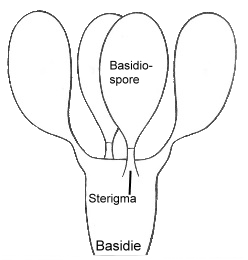
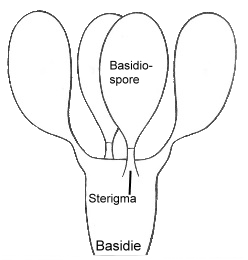
A spore-bearing structure, usually an elongated spore-producing cell of the basidiomycetes, on which spores are formed. A typical basidium produces four spores and is unicellular. Jelly fungi have forked, two-spored basidia. In some fungal groups, basidia may also be divided transversely or longitudinally; these are called phragmobasidia.
Basiphilous
An ecological term for fungal or plant species that occur exclusively or preferentially on basic (alkaline) substrates with a pH above 7.0. Basiphilous fungi are not necessarily calcicolous fungi. See also acidophilous.
Blister gall
A blister gall is a leaf gall caused by gall mites or aphids and related plant lice. It develops through elongation growth of all leaf tissue layers, producing a large cavity occupied by the inducer, for example the gall of the elm sack gall aphid (Tetraneura ulmi).
Brachypterous
Short-winged forms of various organisms, for example insects.
Brown rot
Wood affected by fungal decay becomes brown and characteristically cracked into cubical pieces, also called cubical brown rot. The fungus consumes only the carbohydrates (cellulose), while the brown-coloured lignin remains.
Brownian motion
Brownian motion is the thermal movement of particles in liquids rediscovered by the Scottish botanist Robert Brown. The particles perform completely irregular zigzag movements. Brown observed under the microscope how pollen grains in a drop of water moved in an irregular, twitching manner.
Bryophilous
Growing preferably or exclusively on or among mosses, for example moss cup fungi (Octospora).
Bulbils
Bulbils, also called brood bulblets, are small, seed-like propagules that form in the inflorescences of certain plants such as garlic and Egyptian onions. They serve for vegetative reproduction.
Caeoma
Simple aecia without peridia (caeomata with caeomatospores). The image shows a detail of Coleosporium tussilaginis sensu lato.
Capillitium
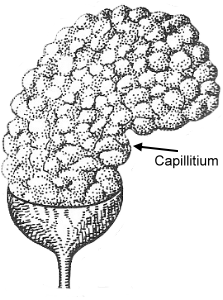
The capillitium is the entire system of hairs or threads inside spore-bearing structures. In mycology, the term is used primarily for the hair-like structures in the mature gleba of gasterothecia, and also for similar structures inside the sporocarps of slime moulds (Myxomycetes).
Cecidology
Cecidology is the scientific study of plant galls. Galls are induced by many different organisms, such as gall wasps, gall midges, leafroller moths, gall mites, fungi, bacteria and viruses. They serve for reproduction or protection against weather and predators. Plant galls develop in different ways. In insects, plant tissue is altered by the injection of cytokinins, producing characteristic gall forms. These injections can stimulate, inhibit or regenerate growth. Histoids and organoids are distinguished. Organoid galls are characterised by changes in individual plant organs, such as changes in shape, anomalies of leaf arrangement and branching, and the formation of new organs. Histoid galls are recognised by changes in plant tissue, such as felt, pith, covering or blister galls, and leaf rolls or folds. Plant galls may also serve as refuges for inquilines (animal species living in abandoned but still inhabited galls, mines, galleries or nests of other species) and parasites, which usually ultimately results in the death of the gall inducer.
Cellulose
Cellulose is the main component of plant cell walls and is therefore the most abundant organic compound and the most common polysaccharide.
Claustral
In myrmecology, claustral colony founding is the process by which an ant queen establishes a colony independently. After mating she sheds her wings, burrows into a founding chamber and seals it. There she lays the first eggs, from which larvae, pupae and later workers develop. The queen supplies the resources for raising the larvae from her own body by breaking down flight muscles and the fat body (fat reserves in the gaster).
Cleistocarpous
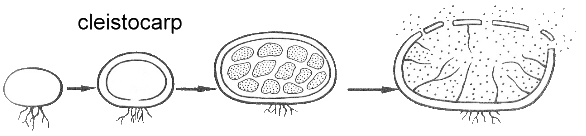
A term for fungal fruiting bodies without a preformed opening or specialised opening mechanism. Spores are released through weathering or, in zoochorous dispersal, through mechanical and/or chemical destruction of the wall, for example in the giant puffball (Calvatia gigantea).
Cleistothecium
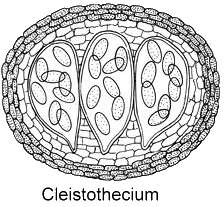
A cleistothecium is an almost spherical ascoma without a preformed opening, with a single- or multilayered wall. Cleistothecia are often surrounded by envelope cells or peridia. The spores are released through mechanical destruction of the cleistothecium or through swelling of internal structures that cause it to rupture. Cleistothecia are formed, for example, by the genera Emericella and Eurotium.
Coleopterocecidia
Coleopterocecidia are plant galls induced by beetles, for example weevils (Curculionidae).
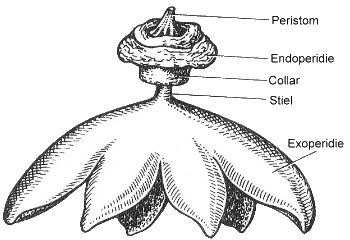
Collar
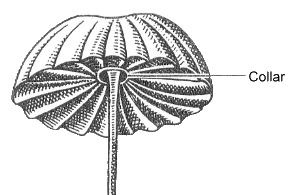
A ring-shaped ledge in the cap flesh separating the gills from the stipe, for example in parasol mushrooms (Macrolepiota), or a ring-shaped collar-like structure, for example on the endoperidium of earthstars (Geastrales).
Commensalism
Commensalism is an interaction between individuals of different species that benefits one species while having a neutral effect on the other. The term is used somewhat differently in different fields. In the original definition, based on the work of the Belgian parasitologist and palaeontologist Pierre-Joseph van Beneden, a commensal is an organism that depends on another species for food by sharing its food resources but, unlike a parasite, does not harm it. In close association, the organism providing the food is called the host and the organism benefiting from it is the commensal. The host experiences neither benefit nor harm. The commensal alone benefits from the association and is usually dependent on the host. It mainly feeds on waste products or surplus food from the host without removing substances essential to the host’s survival.
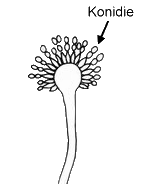
Conidia
Conidia are a type of fungal spore and the term is also used for spores of prokaryotes of the genus Streptomyces. In fungi, they are mitospores and are produced asexually (mitotically), outside the sporangium, either by modification of hyphae or on conidiophores. They are characteristic dispersal structures of vegetative reproduction in higher fungi, including ascomycetes and basidiomycetes.
Conidioma
A fruiting structure of imperfect fungi in which a clearly differentiated fruiting-body wall is formed.
Conidiophore
A conidiophore is a conidium-bearing hypha that is clearly differentiated from the vegetative mycelium.
Coprophilous
coprophilous = dung-, manure- or faeces-inhabiting. In mycology, coprophilous fungi are species that grow preferentially or exclusively on animal excrement.
Cortex
The cortex is the cortical layer of fungal fruiting bodies.
Cortina
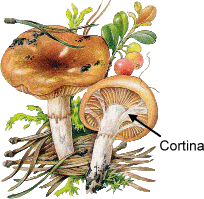
A filamentous or veil-like protective covering, mainly between the cap margin and stipe, as in Cortinariaceae.
Covering gall
A covering gall is produced when the gall inducer stimulates strong, ridge-like growth around itself on the leaf surface and later becomes enclosed by it. A small exit hole often remains through which the insect can leave the gall after development, for example the gall of the beech gall midge (Hartigiola annulipes).
Cryptic species
A cryptic species is a morphologically indistinguishable group or population of organisms in which sexual reproduction with individuals previously regarded as belonging to the same species is impossible or produces only non-viable offspring. This is referred to as reproductive isolation. Since an important criterion in the biological species concept—the ability to reproduce with one another—is not met, the organisms cannot belong to the same species.
Cyanophilous
Able to be stained with aniline blue, methyl blue or cotton blue; important for staining spore ornamentation, for example in coral fungi and cup fungi.
Cystidia
Sterile cells that differ clearly from the surrounding cells. Cystidia occur in the hymenium (hymenial cystidia), on the gill edge (cheilocystidia), on the gill surface (pleurocystidia), in the pileipellis (pileocystidia) and on the stipe surface (caulocystidia). Cystidia whose refractive contents turn yellow with KOH (potassium hydroxide) are called chrysocystidia. Cystidia with oily contents are called gloeocystidia; their contents turn wine-red with sulfovanillin.
Cytokinins
Cytokinins are a group of plant hormones that influence plant growth and development. They also occur in animal tissues, bacteria, fungi and algae.
Daedaloid
Labyrinthine and convoluted.
Detritus
Fine material produced by the decomposition of animal and plant remains; in water, organic suspended or sinking material is also included.
Dextrinoid
Describing cell walls that turn wine-red in Melzer’s reagent.
Diaspore
Diaspore is the botanical collective term for all dispersal units such as seeds, mericarps, fruits, infructescences, spores, bulbils or other vegetative propagules that serve the dispersal of plants or fungi.
Dikarya
Dikarya is a subkingdom of fungi described in 2007 to reflect the shared characteristics of Ascomycota and Basidiomycota in a taxon encompassing both groups.
Diptera
Diptera (true flies) comprise a species-rich order of insects that includes flies and mosquitoes. Unlike other insects, they possess only two wings instead of four.
Dipterocecidia
Dipterocecidia are plant galls induced by gall midges (Cecidomyiidae).
Ectophagous
A term for organisms that feed on the outside of a food plant or host.
Endoparasites
Endoparasites (from endo-, Greek parasitos = parasite), also called internal parasites, are organisms that live inside other organisms, in extreme cases inside cells, for an extended period or throughout their life cycle and obtain food parasitically. In animal endoparasites, distinctions include blood parasites and intestinal parasites. In the latter, mouthparts and the digestive tract are often greatly reduced, and food is absorbed through the entire body surface. Examples include the protozoan Trypanosoma, tapeworms, the snail Entoconcha and the botfly Gasterophilus (Gasterophilidae). Various bacteria and fungi are also endoparasitic. Higher plants such as members of Rafflesiaceae (Cytinus, Rafflesia) may also be described as endoparasites: like fungi, they penetrate the tissues of their host plants and emerge only for flowering.
Endoperidium
The endoperidium is the inner layer of the peridium. It is usually thin and directly encloses the spore mass of gasteroid fungi. With age it becomes papery.
Episporium
The outer layer of the spore wall, which in some fungal groups is clearly differentiated from the other wall layers.
Erineum
Erinea are abnormal local felt-like growths on the surface of leaves of various plant species (felt galls). They are generally gall formations caused by mites, for example felt patches produced by the gall mite Aceria varia.
Euryökous
A term for organisms that tolerate very different environmental conditions.
Exoperidium
The exoperidium is the outer layer of the peridium. In puffballs, for example, it may consist of spines; in earthstars it consists of the lobes that bend outward.
Exsiccatum
Exsiccata are dried specimens or dried vouchers of organisms, especially fungi and plants.
Fairy ring
A ring-shaped arrangement of fungal fruiting bodies in certain fungal species. These develop through unrestricted, circular growth of the mycelium.
Forma
An individual that differs from the main species by a relatively weak characteristic. Forms are classified below the species rank and are roughly comparable to varieties.
Fructification
In mycology, fructification means the formation of fungal fruiting bodies.
Fruiting body
The predominantly visible, temporary part of a fungus that serves to produce and disperse spores. In truffles, it develops underground.
Fungicolous
fungicolous = living on or in fungi. The term applies both to saprophytes specialised on fungal substrates and to fungal parasites.
Funiculum
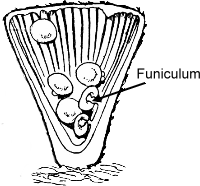
A cord-like, umbilical thread by which the peridioles of bird’s-nest fungi (Cyathus) are attached to the inner cup.
Gall midge
There are about 5,000 species of gall midges (Cecidomyiidae) worldwide, including about 700 species in Central Europe. They owe their name to the formation of galls on various parts of their host plants, such as grasses, shrubs and trees, in which their offspring develop. High concentrations of cytokinins have sometimes been found in the galls, influencing plant and gall growth and development. Gall midges spend most of their lives in the larval stage and some species are parasitic or predatory. Adults live only for a short time. After four larval stages, the developing gall midges pupate in their galls. Gall midges feed exclusively on plants and do not transmit diseases to humans.
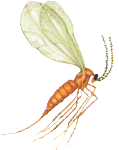
Gall mites
Gall mites (Eriophyidae) are tiny mites only about 0.2 mm long. Through their feeding activity they cause characteristic galls on many different plant species. Depending on the species, these galls may take forms such as shoot deformities or pox-like structures on leaves. Gall mites usually overwinter in leaf axils or between the bud scales of their host plants and move onto the leaves when the plants sprout in spring. Each gall mite species is specialised on a particular host.
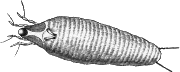
Gall wasp
Gall wasps (Cynipidae) comprise about 1,600 species worldwide and around 300 in Central Europe. Most develop in plant galls, but some also occur in other insects as parasites or parasitoids. Reproduction is either normally sexual or partly parthenogenetic. In most species there is alternation of generations, with a sexual generation and one or more parthenogenetic generations. The larvae develop in galls produced by chemical and/or mechanical stimuli and feed on their tissue.

Gasteroid fungi
Gasteroid fungi (Gastromycetes or Gasteromycetes) are an obsolete form taxon in the fungal kingdom because the polyphyletic origin of the groups assigned to it has since been demonstrated. The taxa concerned are now systematically assigned to the basidiomycetes. Gasteroid fungi are characterised by the fact that basidiospores are formed inside the fruiting body. The spore-bearing part, actually a gasteroid basidiocarp, is called a gasterothecium.
Gasterothecia
Gasterothecia are angiocarpous or cleistocarpous fruiting bodies of gasteroid fungi (Gasteromycetes), for example earthstars (Geastrum), bird’s-nest fungi (Nidularia), splash cups (Cyathus), puffballs (Bovista) and puffballs (Lycoperdon).
Geotropism
Geotropism is the movement of fungi, plants or plant organs towards (positive geotropism) or away from (negative geotropism) the centre of the Earth. Shoots are always negatively geotropic, whereas roots grow positively geotropic. If the position of the substrate changes, for example when a tree bearing fruiting bodies of the tinder fungus falls over, the fungus changes its growth direction after some time.
Germ pore
A thin, pore-like area visible under the microscope at the apical pole of the spore wall, from which the germ tube later emerges. This germ pore occurs only in certain genera of basidiomycetes.
Germ slit
An elongated, slit-like thinning of the spore wall in certain ascomycetes, for example in Xylariaceae, usually along the long side of the spore.
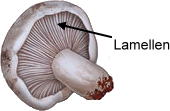
Gills
Radially arranged plates on the underside of agaric fungi. They increase the surface area of the fertile layer located on their sides. Ridges, spines and tubes in other fungi serve the same purpose.
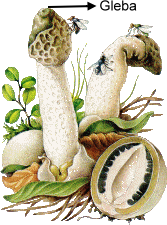
Gleba
In mycology, the gleba is the fertile part of angiocarpous and cleistocarpous (cleistothecial) basidiomycetes.
Guaiac tincture
A resin obtained from the guaiac tree, dissolved in alcohol, which can produce a blue coloration on fungal fruiting bodies.
Guttation
The excretion of liquid secretions in the form of droplets.
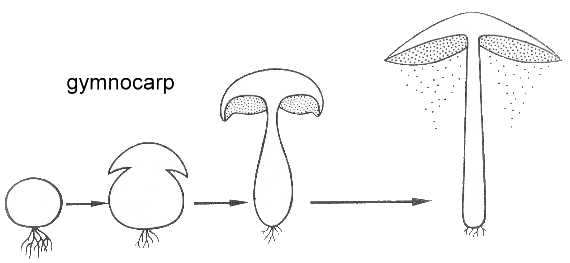
Gymnocarpous
Gymnocarpous fungal fruiting bodies are those in which the asci or basidia develop on the surface and remain uncovered by the fruiting-body wall, velum or similar structures throughout development until spore maturity.
Haplometrosis / Haplometrosis
In social insects, especially ants, the presence of only one egg-laying queen; the opposite is pleometrosis (polygyny).
Helminthocecidia
Helminthocecidia are plant galls caused by certain nematodes.
Hemiptera
An order of insects with sucking and piercing mouthparts forming a segmented beak, usually with incomplete metamorphosis; examples include true bugs, cicadas, aphids and wingless forms.
Hemipterocecidia
Hemipterocecidia are plant galls caused by sap-sucking insects such as aphids and plant bugs.
Heterogony
Heterogony is the alternation of sexual and asexual reproduction from one generation to the next.
Histoid
Histoid means tissue-like. In the context of plant galls, it refers to changes in plant tissue such as felt, pith, covering or blister galls, and leaf rolls and folds.
Holomorph
In mycology, holomorph denotes a pleomorphic fungal species (excluding lichens) with all its reproductive forms: the teleomorph as the main fruiting stage producing meiospores, and at least one anamorph as the secondary fruiting stage producing mitospores, or entirely without spores.
Hyaline
Colourless and translucent.
Hygrophanous
Changing colour when the moisture state changes.
Hymeniform
A term describing a hymenium-like structure of the pileipellis in certain fungal groups, for example Agrocybe.
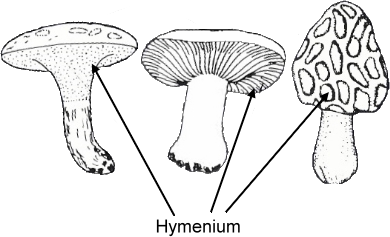
Hymenium
The fertile or spore-producing layer of a fungal fruiting body, in which basidia or asci stand closely together. In agarics, the gill surfaces, for example, are covered by a hymenium.
Hymenoptera
Hymenoptera (wasps, bees and ants) comprise a species-rich insect order including bees, wasps and ants.
Hymenopterocecidia
Hymenopterocecidia are plant galls caused by sawflies and gall wasps.
Hypermetamorphosis
Hypermetamorphosis is a form of ontogenetic development in which the morphological characteristics of an animal change fundamentally several times during individual development. It is therefore a development involving multiple metamorphic stages. It occurs mainly in insects and other invertebrates whose successive larval stages occupy different habitats. It is particularly common in temporary parasites, which generally develop not only a parasitic form but also a dispersal stage and an adult form. Well-known examples include blister beetles, mantispids and parasitoid wasps.
Hyperparasite
A parasite that attacks other parasites, for example some ichneumon wasps.
Immature
Being in the juvenile stage before sexual maturity.
Imperfect fungi
Imperfect fungi, also called Fungi imperfecti (Deuteromycetes), are higher fungi (ascomycetes, basidiomycetes or zygomycetes) whose life cycle lacks a known sexual stage or in which the sexual stage has not yet been discovered. Reproduction occurs through asexual spores (conidia) or purely vegetatively.
Inquiline
Inquilines are animal species that live in abandoned but still inhabited galls, mines, galleries or nests of other species.
Juvenile
In biology, juvenile refers to the childhood and developmental stages of an organism before sexual maturity.
Kataplasmatic
In cecidology (the study of plant galls), the term describes a particular tissue modification caused by organisms such as insects, bacteria or fungi. Kataplasmatic galls do not have constant shape or size. Almost all mycocecidia are kataplasmatic, as are galls caused by bacteria, algae and many hemipterans. The size of the resulting gall may vary considerably.
Latency period
The period between eating a mushroom and the appearance of the first symptoms of poisoning.
Leaf rolling, leaf folding
Leaf rolling and leaf folding result from faster growth of the lower side of a leaf or inhibition of growth on its upper side. This can produce bends or oval-shaped folds on the upper surface that shelter the inducer from environmental influences and predators, for example leaf rolling by the sawfly Phyllocoptes goniothorax, or leaf folding caused by the gall midge Macrodiplosis pustularis.
Lichenicolous
lichenicolous = living on lichens. Lichenicolous fungi grow on lichens and are usually parasites, more rarely saprophytes.
Lignicolous
lignicolous = living on wood. Lignicolous fungi inhabit and decompose wood. Many are saprophytes, while some are parasites.
Lignin
Lignin is a structural biopolymer incorporated into plant cell walls and responsible for the lignification of cells. See also Wikipedia.
Lugol’s reagent
Lugol’s solution is used in fungal microscopy to stain the ascus pore or ascus apex of ascomycetes blue.
Macropterous
Fully winged forms of various organisms, for example insects.
Melzer’s reagent
Melzer’s reagent is a solution of elemental iodine, potassium iodide and chloral hydrate in water. It is a diagnostic reagent used particularly in mycology. Apart from water, it is one of the most commonly used media for examining fungi. Melzer’s reagent has become a popular mounting medium in herbarium taxonomy because it optically homogenises and clears often troublesome dead cell contents; its high viscosity also suppresses Brownian motion.
Merulioid
Folded and convoluted.
Mesophilous
Preferring habitats with moderate temperatures or moderate moisture conditions.
Metamorphosis
In zoology, metamorphosis, also called metabolosis, is the transformation from the larval stage into the adult, sexually mature stage.
Micropterous
Short-winged forms of various organisms, for example insects.
Morphe
In modern terminology, a term for a developmental stage.
Mutualistic
In biology and ecology, mutualistic describes a beneficial interaction between organisms of different species in which both partners benefit. It ranges from a loose association, such as pollination, to an obligate symbiosis, such as lichens, in which the partners depend on one another.
Mycelium
The mycelium is the totality of all hyphae, the thread-like cells of a fungus. It is the actual fungus: an often invisible network of hyphae in the soil or, in wood-inhabiting fungi, within wood. Fungal mycelia can cover more than one square kilometre and may reach a considerable age, as in Armillaria.
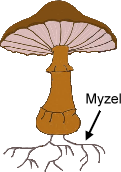
Mycobiont
The fungal partner in a lichen symbiosis. More than 99% of mycobionts are ascomycetes, and about one third of all ascomycete species are lichenised. Only a few lichenised species are known among basidiomycetes.
Mycocecidia
Mycocecidia are plant galls caused by fungi.
Mycology
Mycology is the scientific study of fungi.
Mycorrhiza
A mutually beneficial association between a fungus and a higher plant. The fungus comes into contact with the plant’s fine root system, supplying the plant with mineral nutrients and water, while receiving in return a share of the assimilates produced by photosynthesis, such as essential carbohydrates.
Myrmecology
The scientific study of ants.
Nectarivorous
A term for animals that use nectar as a food source.
Nematocecidia
Nematocecidia are plant galls caused by various nematodes.
Nematodes
Nematodes are tiny roundworms belonging to one of the most species-rich animal phyla, with more than 20,000 species. Some species, such as the stem nematode (Ditylenchus dipsaci), can produce tissue distortions and hence galls through toxic components of their saliva that break down the middle lamellae between plant cells. They are regarded as pests of crops such as potatoes, sugar beet and tobacco.

Neophyte
Neophytes are plants introduced by humans, directly or indirectly and intentionally or unintentionally, after 1492—the year traditionally associated with Christopher Columbus’s discovery of America—to areas in which they did not naturally occur.
Oak gall
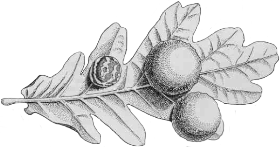
An oak gall occurring on the underside of oak leaves, induced by gall wasps of the genus Cynips.
Oligolecty
Oligolecty describes a foraging and dietary strategy in bees. A bee species is termed oligolectic when females collect pollen exclusively from one plant species or closely related species and use it to provision their nests with larval food.
Ontogeny
Ontogeny is the development of an individual organism. The temporal course of individual development is also called developmental history. It describes the successive stages from germ-cell development through the fully developed adult stage and also includes age-related degeneration.
Operculum
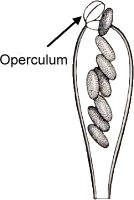
A lid-like closure at the apex of the asci. It is, for example, characteristic of the Pezizales.
Organoid
organoid means organ-like. In the context of plant galls, it refers to changes in individual plant organs, such as changes in form, anomalies of leaf arrangement or branching, and the formation of new organs.
Paraphyses
Paraphyses are sterile, hair-like cells in the hymenium of ascomycetes, located between the asci. Their shape and colour can sometimes be used for identification.
Parasite
A parasite is an organism that obtains food at the expense of another organism (the host), thereby harming it and potentially causing the host’s death.
Parasite (mycology)
A parasitic fungus attacks living organisms, whether healthy or weakened, damages them and may eventually cause their death.
Parasitoid
A parasitoid is an animal that lives parasitically during its development and subsequently kills its host.
Parthenogenesis
In parthenogenesis, also called agamy, offspring develop from unfertilised eggs. It is a form of asexual reproduction.
Peridermium
Aecia with walls that are initially closed like a dome (peridermia producing peridermiospores).
Peridiole
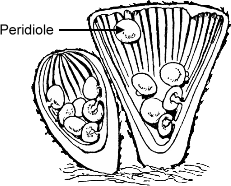
Peridioles are components of the gleba of gasterothecia. They are lens- to disc-shaped, about 1–2 mm in diameter, each containing a glebal chamber and enclosed by a secondary peridium. They function as diaspores. Initially, each peridiole is connected to the peridium by a strand of trama. These strands become mucilaginous and serve as attachment threads when the peridioles are ejected by water droplets from the funnel-shaped, mature fruiting bodies.
Peridium
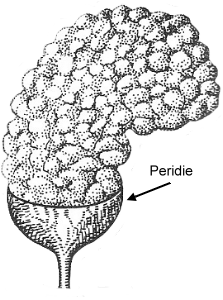
A multilayered, persistent outer wall of the fruiting bodies of gasteroid fungi that does not become transformed into spore mass.
Perithecium
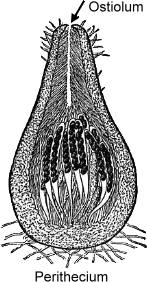
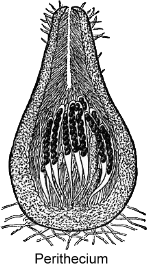
Perithecia are pear-, spherical- or flask-shaped fruiting bodies of ascomycetes or lichens. Unlike an apothecium, a perithecium does not have an exposed fertile disc.
Petrophilous
Preferring or inhabiting rocky or stony habitats.
Phytocecidia
Phytocecidia are plant galls caused by plant parasites such as ascomycetes and rust fungi.
Phytoparasitism
Phytoparasitism is the parasitic acquisition of resources from plants. Phytoparasites obtain essential resources from a host plant, which often provides them with nutrients.
Phytoptocecidia
Phytoptocecidia are plant galls caused by mites.
Pith gall
A type of gall in which growth originates in the inner layers of the plant; such galls are particularly characteristic of gall wasps.
Plectenchyma
Plectenchyma (interwoven tissue, pseudotissue) is a term from plant morphology. It is found particularly in red algae and fungal fruiting bodies. At first glance it may resemble true tissue, but it actually consists of adhering, fused or interwoven cell filaments. Unlike true tissue, cellular connections such as pits occur only within the individual filaments.
Pleometrosis
In pleometrosis, several ant queens or queens of other social hymenopterans (and, very rarely, termites) establish a colony together. They lay eggs jointly and also care for the brood together. Although pleometrotic foundation is known in a number of species, it is relatively uncommon in nature. Pleometrosis is often, but not always, associated with several fertile, egg-laying reproductive individuals in a colony (polygyny). The opposite condition, in which a queen establishes a new colony alone and independently of other queens, is called haplometrosis (or haplometrosis).
Pleomorphism
In biology, pleomorphism refers to the occurrence of multiple forms in certain microorganisms or cells of multicellular organisms.
Polygyny
In biology, polygyny generally refers to a mating system in which a male mates with several females during a reproductive period; it is a form of polygamy.
Polylecty
The collection of pollen from many different flowering plants by polylectic bees. Such species can also be described as pollen generalists. Many nevertheless show preferences for particular plants while avoiding others.
Prosoplasmatic
A specialised tissue produced through gall formation. Prosoplasmatic galls are those whose shape and size characteristics are highly characteristic of the particular gall type. They are produced mainly by dipterans and hymenopterans, as well as by many mites and hemipterans.
Psychrophilic
A preference for lower temperatures.
Reagent
A reagent is a substance used to identify another substance, i.e. a detecting agent in an analytical reaction. Adding the reagent causes a chemical reaction that produces a characteristic precipitate or colour change, allowing conclusions to be drawn about the presence or absence of particular ions or functional groups. Many reagents are named after their developers or discoverers, such as Melzer’s reagent.
Receptaculum
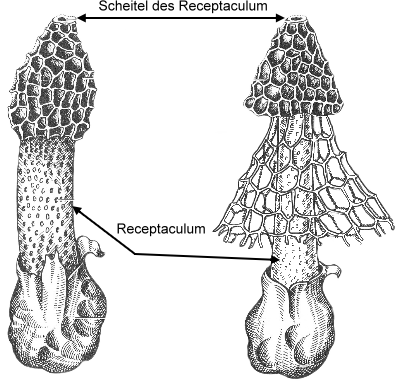
A spongy, chambered, highly extensible pseudoparenchymatous structure of the gasterothecia of the Phallales (stinkhorns). As the receptaculum elongates, the mature gleba is lifted after the peridium ruptures, exposing it to insects. The receptaculum may be stalk-shaped, candelabra-like or reticulately branched. In Phallus (stinkhorns), it is divided into cap and stalk; in some Phallaceae, a veil (indusium) occurs in addition. Such fruiting bodies are known as veiled stinkhorns.
Resupinate
Lying flat against the substrate without forming a cap.
Rhizomorphs
Rhizomorphs are thickened mycelial strands found in some basidiomycetes and composed of outer and inner hyphae. The outer layer is usually strongly thickened, pigmented and sclerotised. Rhizomorphs resemble plant roots and also serve to transport substances. They are mainly used to reach new substrate sources, but may also transport materials to fruiting bodies at more distant locations. Rhizomorphs are well known in Armillaria, which use them not only in mycorrhizal associations but also to penetrate the root systems of host trees.
Roestelia
Aecia with lattice-like wall structures (roestelia producing roesteliospores). The image shows a detail of pear trellis rust (Gymnosporangium sabinae).
Rust fungi
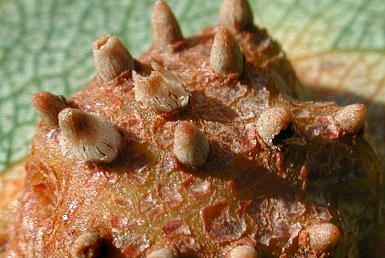
Rust fungi or rust-like fungi (Pucciniales) are an order of basidiomycetes (Basidiomycota). They are plant parasites and mainly infect shoots and leaves. They have a complex life cycle that often includes host alternation. Many species are economically important because they infect crop plants.
Saprophyte
A fungus that feeds on and decomposes dead organic matter such as leaves, wood or carcasses.
Sclerotium
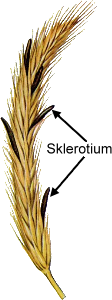
A tuberous to clump-shaped persistent structure from which fruiting bodies may develop under favourable conditions.
Setae
Setae are thick-walled, brown, cystidia-like structures that may occur in the hymenium, pileipellis or mycelium. They usually project prominently and can already be seen with a strong hand lens.
Sexuparae
Parthenogenetically produced generation of aphids.
Siderophilous
siderophilous = iron-loving. Siderophily is a feature of some agaric genera in which a blackish double granulation appears in the basidia after treatment with a solution containing metal ions and carmine-acetic acid. This microscopic reaction results from complex formation between the metals, carmine and certain protein compounds in the basidia.
Slime moulds
Slime moulds (Mycetozoa or Eumycetozoa) are a taxon of unicellular organisms whose way of life combines characteristics of animals and fungi, but which belong to neither group. Despite their name, they are not fungi. The group comprises just over 1,000 species, although the number is considered uncertain. According to modern views, slime moulds no longer constitute a single common group. The three included taxa, Myxogastria, also known as myxomycetes and the largest group, Dictyostelia and Protostelia, are no longer combined. Within biology, the systematic study of slime moulds is carried out in botany and mycology.
Sporangium
In botany, a sporangium is a structure in which spores are produced. Sporangia occur in fungi, algae and all plants.
Spores
Microscopically small dispersal units of spore-producing organisms such as fungi, ferns and mosses. Spores are often important for identifying fungi.
Sporocarp
A sporocarp is the spore-producing fruiting body of slime moulds.
Staining reagents
Substances or dyes that produce reactions in particular structures which become visible as colour changes. Some are used to improve the contrast of particular structures. Others reveal specific reactions that may provide characters important for taxonomy or identification.
Stenökous
A term for organisms that cannot tolerate large fluctuations in environmental conditions and therefore have a narrow ecological tolerance.
Stenopterous
Narrow-winged forms of various organisms, for example insects.
Sterigma
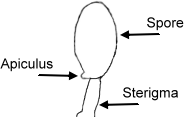
A sterigma (plural: sterigmata) is a stalk- to finger-shaped projection on a basidium on which a basidiospore is formed. Sterigmata are also called spore-bearing projections.
Stroma
A usually firm, fruiting-body-like structure of the vegetative mycelium composed of plectenchyma, on or in which several, often many, individual fruiting bodies develop.
Sulfovanillin
A reagent for macroscopic and microscopic examinations (1 g vanillin in 10 ml of 75% sulphuric acid). It is used to stain various structures, particularly in Russulales.
Symbiosis
Symbiosis refers to an association between individuals of two different species that is beneficial to both partners.
Taxon
In biology, a taxon (plural: taxa) is a group of organisms recognised as a systematic unit.
Taxonomy
A taxonomy or classification scheme is a consistent method or model for classifying objects within a particular field according to defined criteria, assigning them to particular categories or classes (taxa; see taxon).
Teleomorph
In mycology, the teleomorph is the sexual stage of a fungus with a pleomorphic life cycle, in which meiospores are produced. By contrast, an anamorph is an asexual stage that produces only mitospores (conidia).
Telium
A telium is a type of spore-bearing structure occurring in the main fruiting stage of rust fungi (Pucciniales).
Terminology
Terminology is the complete set of specialist terms (termini) used in a particular field. It forms part of the technical language of that field.
Terrestrial
Living in or on the soil.
Thermophilic
A preference for higher temperatures.
Trama
Trama is the fleshy plectenchymatous tissue of a fungus lying between the surfaces, comprising the cap and stipe but not the mycelium. A distinction is sometimes made between stipe trama and cap trama. In a narrower sense, the term refers only to the sterile hyphal tissue of polypores and agarics, excluding the surface tissue.
Trophobiosis
Trophobiosis is an interaction between an organism that provides food and another organism that consumes it in return for a benefit such as protection. The food is often a bodily secretion or similar substance. A well-known example is the mutualistic relationship between ants (Formicidae) and aphids (Aphidina), in which aphids provide honeydew and receive protection from the ants.
Uredium
A uredium or uredinium is a type of spore-bearing structure in rust fungi (Pucciniales).
Velum
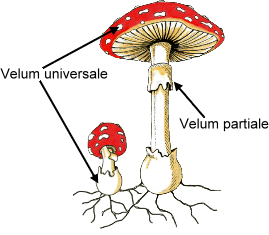
A membranous or cobweb-like protective covering on young fruiting bodies that ruptures as the fruiting body expands and remains as a ring on the stipe or as a fringe at the cap margin. The cobweb-like, filamentous velum of Cortinarius and related fungi is called a cortina. A distinction is made between the universal veil (velum universale), which covers the entire young fruiting body, and the partial veil (velum partiale), which protects the young gills.
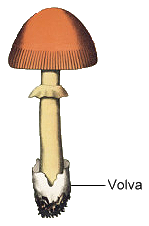
Volva
A membranous to sheath-like covering at the base of some basidiocarps. The volva develops from the universal veil of the young fruiting body, with all or part of that veil contributing to its formation.
White rot
A form of fungal decay in trees. As the fungus consumes lignin and cellulose, the affected wood becomes pale or whitish while retaining its fibrous structure. Its strength is greatly reduced.
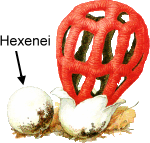
Witch’s egg
An immature egg- to spherical-shaped fruiting body surrounded by a thick gelatinous sheath in some gasteroid fungi (Phallaceae, Clathraceae), for example the stinkhorn (Phallus impudicus).
Xerothermic
Living in a habitat with a dry, warm climate.
Xylobiont
Xylobiont (from Greek xylos, wood, and bios, life) means “inhabiting wood”, “living in wood” or “wood-dwelling”. Xylobionts feed wholly or partly on wood, inhabit it, or use the cellulose contained in wood for nest construction. Xylobionts may be fungi (wood-inhabiting fungi) or animals. Among animals, insects make up most xylobionts, especially beetles such as members of the longhorn beetle family.
Zoocecidia
Zoocecidia are plant galls caused by animal parasites.
Zoochorous
Zoochory is the dispersal of diaspores, such as seeds, of various plants by animals.
TOP