
This glossary explains biological, botanical, zoological and mycological terms, as well as terms used in cecidology. It is intended to make the numerous technical terms used in the photo gallery and on the information pages of this website easier to understand.
All | A | B | C | D | E | F | G | H | I | J | K | L | M | N | O | P | Q | R | S | T | U | V | W | X | Y | Z |

Macropterous
Fully winged forms of various organisms, for example insects.
Melzer’s reagent
Melzer’s reagent is a solution of elemental iodine, potassium iodide and chloral hydrate in water. It is a diagnostic reagent used particularly in mycology. Apart from water, it is one of the most commonly used media for examining fungi. Melzer’s reagent has become a popular mounting medium in herbarium taxonomy because it optically homogenises and clears often troublesome dead cell contents; its high viscosity also suppresses Brownian motion.
Merulioid
Folded and convoluted.
Mesophilous
Preferring habitats with moderate temperatures or moderate moisture conditions.
Metamorphosis
In zoology, metamorphosis, also called metabolosis, is the transformation from the larval stage into the adult, sexually mature stage.

Micropterous
Short-winged forms of various organisms, for example insects.
Morphe
In modern terminology, a term for a developmental stage.
Mutualistic
In biology and ecology, mutualistic describes a beneficial interaction between organisms of different species in which both partners benefit. It ranges from a loose association, such as pollination, to an obligate symbiosis, such as lichens, in which the partners depend on one another.
Mycelium
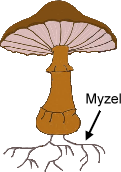
The mycelium is the totality of all hyphae, the thread-like cells of a fungus. It is the actual fungus: an often invisible network of hyphae in the soil or, in wood-inhabiting fungi, within wood. Fungal mycelia can cover more than one square kilometre and may reach a considerable age, as in Armillaria.
Mycobiont
The fungal partner in a lichen symbiosis. More than 99% of mycobionts are ascomycetes, and about one third of all ascomycete species are lichenised. Only a few lichenised species are known among basidiomycetes.
Mycocecidia
Mycocecidia are plant galls caused by fungi.
Mycology
Mycology is the scientific study of fungi.
Mycorrhiza
A mutually beneficial association between a fungus and a higher plant. The fungus comes into contact with the plant’s fine root system, supplying the plant with mineral nutrients and water, while receiving in return a share of the assimilates produced by photosynthesis, such as essential carbohydrates.
Myrmecology
The scientific study of ants.
TOP