
This glossary explains biological, botanical, zoological and mycological terms, as well as terms used in cecidology. It is intended to make the numerous technical terms used in the photo gallery and on the information pages of this website easier to understand.
All | A | B | C | D | E | F | G | H | I | J | K | L | M | N | O | P | Q | R | S | T | U | V | W | X | Y | Z |

Saprophyte
A fungus that feeds on and decomposes dead organic matter such as leaves, wood or carcasses.
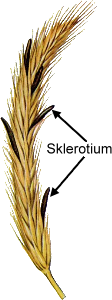
Sclerotium
A tuberous to clump-shaped persistent structure from which fruiting bodies may develop under favourable conditions.
Setae
Setae are thick-walled, brown, cystidia-like structures that may occur in the hymenium, pileipellis or mycelium. They usually project prominently and can already be seen with a strong hand lens.
Sexuparae
Parthenogenetically produced generation of aphids.
Siderophilous
siderophilous = iron-loving. Siderophily is a feature of some agaric genera in which a blackish double granulation appears in the basidia after treatment with a solution containing metal ions and carmine-acetic acid. This microscopic reaction results from complex formation between the metals, carmine and certain protein compounds in the basidia.
Slime moulds
Slime moulds (Mycetozoa or Eumycetozoa) are a taxon of unicellular organisms whose way of life combines characteristics of animals and fungi, but which belong to neither group. Despite their name, they are not fungi. The group comprises just over 1,000 species, although the number is considered uncertain. According to modern views, slime moulds no longer constitute a single common group. The three included taxa, Myxogastria, also known as myxomycetes and the largest group, Dictyostelia and Protostelia, are no longer combined. Within biology, the systematic study of slime moulds is carried out in botany and mycology.
Sporangium
In botany, a sporangium is a structure in which spores are produced. Sporangia occur in fungi, algae and all plants.
Spores
Microscopically small dispersal units of spore-producing organisms such as fungi, ferns and mosses. Spores are often important for identifying fungi.
Sporocarp
A sporocarp is the spore-producing fruiting body of slime moulds.
Staining reagents
Substances or dyes that produce reactions in particular structures which become visible as colour changes. Some are used to improve the contrast of particular structures. Others reveal specific reactions that may provide characters important for taxonomy or identification.
Stenökous
A term for organisms that cannot tolerate large fluctuations in environmental conditions and therefore have a narrow ecological tolerance.
Stenopterous
Narrow-winged forms of various organisms, for example insects.
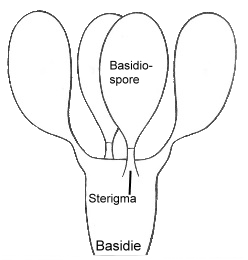
Sterigma
A sterigma (plural: sterigmata) is a stalk- to finger-shaped projection on a basidium on which a basidiospore is formed. Sterigmata are also called spore-bearing projections.
Stroma
A usually firm, fruiting-body-like structure of the vegetative mycelium composed of plectenchyma, on or in which several, often many, individual fruiting bodies develop.
Sulfovanillin
A reagent for macroscopic and microscopic examinations (1 g vanillin in 10 ml of 75% sulphuric acid). It is used to stain various structures, particularly in Russulales.
Symbiosis
Symbiosis refers to an association between individuals of two different species that is beneficial to both partners.
TOP