This glossary explains biological, botanical, zoological and mycological terms, as well as terms used in cecidology. It is intended to make the numerous technical terms used in the photo gallery and on the information pages of this website easier to understand.
All | A | B | C | D | E | F | G | H | I | J | K | L | M | N | O | P | Q | R | S | T | U | V | W | X | Y | Z |

Haplometrosis / Haplometrosis
In social insects, especially ants, the presence of only one egg-laying queen; the opposite is pleometrosis (polygyny).
Helminthocecidia
Helminthocecidia are plant galls caused by certain nematodes.
Hemiptera
An order of insects with sucking and piercing mouthparts forming a segmented beak, usually with incomplete metamorphosis; examples include true bugs, cicadas, aphids and wingless forms.
Hemipterocecidia
Hemipterocecidia are plant galls caused by sap-sucking insects such as aphids and plant bugs.
Heterogony
Heterogony is the alternation of sexual and asexual reproduction from one generation to the next.
Histoid
Histoid means tissue-like. In the context of plant galls, it refers to changes in plant tissue such as felt, pith, covering or blister galls, and leaf rolls and folds.
Holomorph
In mycology, holomorph denotes a pleomorphic fungal species (excluding lichens) with all its reproductive forms: the teleomorph as the main fruiting stage producing meiospores, and at least one anamorph as the secondary fruiting stage producing mitospores, or entirely without spores.
Hyaline
Colourless and translucent.
Hygrophanous
Changing colour when the moisture state changes.
Hymeniform
A term describing a hymenium-like structure of the pileipellis in certain fungal groups, for example Agrocybe.
Hymenium
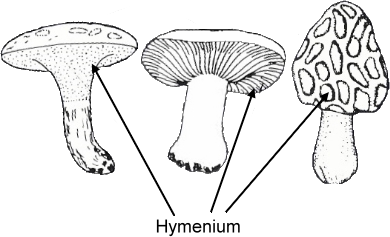
The fertile or spore-producing layer of a fungal fruiting body, in which basidia or asci stand closely together. In agarics, the gill surfaces, for example, are covered by a hymenium.
Hymenoptera
Hymenoptera (wasps, bees and ants) comprise a species-rich insect order including bees, wasps and ants.
Hymenopterocecidia
Hymenopterocecidia are plant galls caused by sawflies and gall wasps.
Hypermetamorphosis
Hypermetamorphosis is a form of ontogenetic development in which the morphological characteristics of an animal change fundamentally several times during individual development. It is therefore a development involving multiple metamorphic stages. It occurs mainly in insects and other invertebrates whose successive larval stages occupy different habitats. It is particularly common in temporary parasites, which generally develop not only a parasitic form but also a dispersal stage and an adult form. Well-known examples include blister beetles, mantispids and parasitoid wasps.
Hyperparasite
A parasite that attacks other parasites, for example some ichneumon wasps.
TOP